
2025 Guide to Evora Megaliths: Portuguese Stonehenge

Trying to figure out if the Evora Megaliths are worth visiting and how to explore them?
You’re in the right place. We know how tricky planning can be when clear info is hard to find.
Having spent over a month in Portugal with a special segment focused on Evora and its Megalithic sites, we’re here to provide all the details.
There are 3 primary sites of megalithic structures outside of Evora that are definitely worth a visit – even if you can only see the main one!
The Evora Megaliths are fun no matter if you’re a history enthusiast, an adventure seeker, or simply a curious traveler.
Plus, they are FREE and lack the big crowds that other Megalithic sites have like Stonehenge.
Let’s dive into what the Evora Megaliths are, how to visit them, and what you can expect when visiting each site.
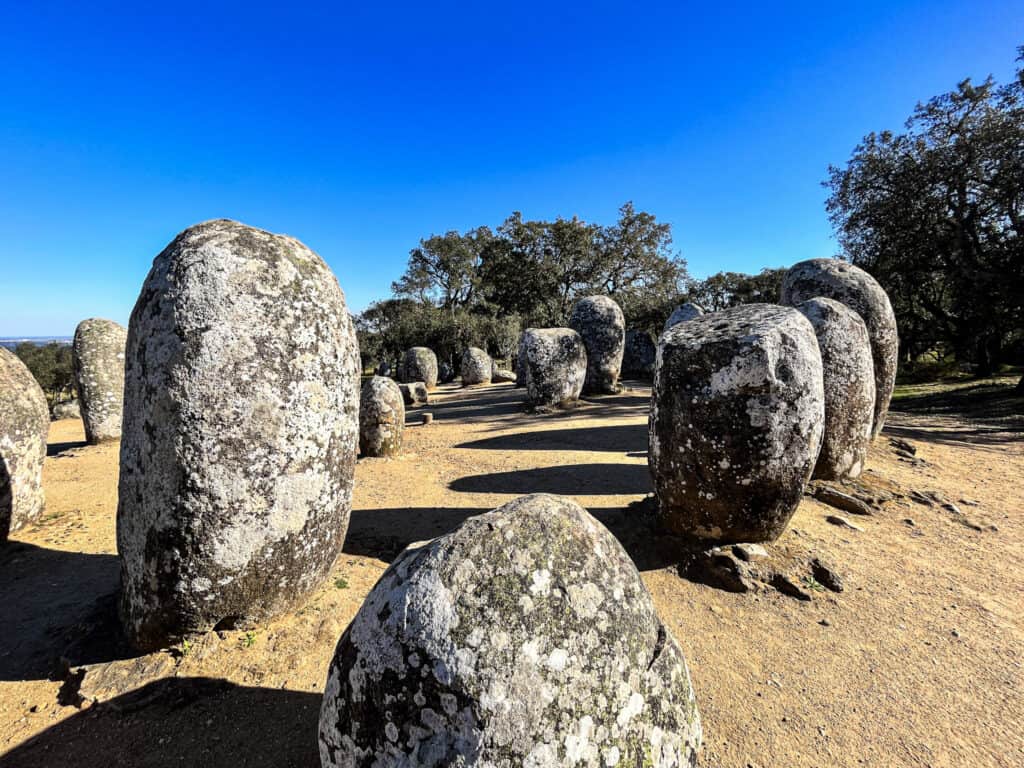
What are the Evora Megaliths?
The Evora Megaliths refer to a collection of megalithic monuments located in the outskirts of Évora and throughout central Alentejo in Portugal.
If you are like us… you might be asking yourself “What is a megalithic monument?”
To that, we say think of the Portuguese version of Stonehenge.
Here is a breakdown of the specific types:
- Cromlech: A prehistoric arrangement of standing stones commonly encircling a mound or dolmen.
- Dolmen: A prehistoric burial chamber.
- Megalith: A sizable stone used in the construction of a monument or structure, either independently or in conjunction with other stones without the use of mortar.
- Menhir: A tall, upright stone, either standing alone or forming part of a group.
- Monolith: An individual massive stone block.
The Alentejo region, particularly the Evora district, is considered one of the most important megalithic sites in the Iberian Peninsula and Europe.
The concentration of megalithic structures includes more than 10 megalithic enclosures, over 100 isolated menhirs, around 800 dolmens, and close to 450 megalithic settlements.
While they are spread out in the region, 3 main sites can be visited outside of Evora: Cromeleque dos Almendres, Dolmen of Barrocal, and Great Dolmen of Zambujeiro.

The significance of the megalithic monuments in the Evora region is associated with its unique geographical position as the only place where the hydrographical basins of the Tagus, Sado, and Guadiana rivers intersect.
This made the region an essential crossing point for ancient communities.
Exploring the Evora Megaliths provides insight into the ancient history and cultural practices of the Neolithic communities in the region.
The sites offer a unique opportunity to witness megalithic structures that predate even the more famous Stonehenge, and they are known for being older, free to visit, less crowded, and allowing visitors to walk through the grounds.
Why Should You Visit the Evora Megaliths?
Wondering why visiting these stones is worth your time? Our top reasons are:
- They are some of the oldest Megaliths discovered ever! Even older than Stonehenge.
- They are FREE – unlike most megalithic sites (cough Stonehenge), these sites are completely free to visit
- No crowds – while you may see other visitors or the occasional tour group, there are rarely crowds visiting the Evora Megalithic sites.
- Visiting the Evora Megalithic sites is also a great way to visit the Portuguese countryside and see the famous cork trees up close! They are fascinating and really beautiful.

How to Visit the Evora Megaliths
The Evora Megaliths are on the outskirts of Evora and are inaccessible by public transportation.
For this reason, we recommend visiting either by car or on an Evora tour. Both have their benefits, but overall we recommend a tour!
Why? You get SO much more context with a guide. Otherwise, it might feel a bit like you’re just looking at rocks.
Plus, you can relax instead of worrying about the logistics.
Visiting the Evora Megaliths By Tour
Best Evora Megaliths Tour from Lisbon
Visiting the Portuguese Stonehenge from Lisbon is an EXCELLENT day trip, especially if you pair it with a tour of lovely Évora!
We found so much in this region to fall in love with so if you don’t have time for a couple of days, a day trip is a must.
We love this tour from Lisbon – you’ll explore the UNESCO-designated town of Evora, visiting the top spots like the Roman Temple of Diana, the 12th-century Cathedral of Évora, and the fascinating Chapel of Bones.
After exploring the city center, the tour wraps up with a visit to the Almendres Cromlech. You’ll travel in a small group via a minivan with an expert guide. It really is worth it!
Best Evora Megaliths Tour from Evora
Already in Evora? YAY – we adored our stay there!
Check out this tour of the Evora Megaliths – You’ll have an outstanding guide who really brings the entire experience to life with their stories!
The tour includes visiting the 3 main Evora megalith sites: Cromeleque dos Almendres, Dolmen of Barrocal, and Great Dolmen of Zambujeiro.
Also, we loved learning about the “Montado,” Portuguese for Cork oak forest! Their ecological richness and sustainable cork harvesting practices play a crucial role in biodiversity conservation.
Visiting the Evora Megaliths By Car
The largest of the Evora megaliths, Cromeleque dos Almendres, is a 30-minute drive from Evora or a 90-minute drive from Lisbon.
The drive from Lisbon will be mostly interstate until you exit to take N114 south. If you’re coming from Evora, you’ll take N114 out of Evora for a little over 17 km.
From N114, you’ll turn onto Ria dos Penedos and travel through the town of Nossa Sra. de Guadalupe.

You’ll drive a bit further before you come to the Cromeleque dos Almendres Visitor Center. We recommend stopping inside to talk to a visitor center employee who will give you more information about visiting the megaliths.
The signs outside the visitor center also provide a ton of information about the megaliths as there are no good signs and information at the megalith sites.
Once you pass the visitor center, you’ll drive on a non-paved road to reach the megaliths.
Visiting Cromeleque dos Almendres
Cromeleque dos Almendres or The Cromlech of the Almendres is the main Evora Megalith site. It is the easiest to access and the one to prioritize if you only have time to visit 1 place.
During your visit, we recommend starting with the visitor center!

Cromeleque dos Almendres Visitor Center
We completely missed the visitor center when we first visited Almendres Cromlech.
It is just to the right when you are leaving the town of Nossa Senhora de Guadalupe and starting the dirt road to the megaliths. Here is the Google Maps link!
Luckily, we saw it as we were leaving and it is 1,000% worth stopping by – ideally first 🙂
The visitor’s center has a series of excellent references as well as artifacts (or replicas of artifacts) to learn from.
After you visit the visitor’s center, you’ll head to the main Megalith site which is a few miles down the road. The signage there is pretty sunwashed so get your knowledge before you go (or go with a guide!).
We enjoyed exploring the rock formations and searching for markings on the rocks. Nicholas was good at finding them!

It is believed that this was constructed for ritualistic, ceremonial, and possibly astronomical functions. We had fun imagining this!
The area is surrounded by cork trees which is also fun to explore! We learned that the number on the cork tree is indicative of the year it was last harvested.
Overall, a visit to Almendres Cromlech can be accomplished in an hour or so.
Almendres Menhir
If you have time, stop by the Menhir dos Almendres on your drive back to the main road – it is just one big stone, but it is impressive!
There is a pull-off about halfway down the non-paved road for the trail to Almendres Menhir. The walk is uneven and not easy here, so skip if you have mobility concerns.

There were pretty flowers blooming when we visited which made the walk extra enjoyable!
The full detour to Menhir dos Almendres is about 15-20 minutes, including walking time.
Visiting Great Dolmen of Zambujeiro
The Great Dolmen of Zambujeiro or Anta Grande do Zambujeiro, is located about 25 minutes from Cromeleque dos Almendres, just outside the town of Valverde.
The Great Dolmen of Zambujeiro is a large stone chamber covered by a massive capstone, supported by several upright stones.
The purpose of dolmens like Zambujeiro is believed to have been for burial or ritualistic practices.

The Great Dolmen of Zambujeiro is the largest found structure of its kind in the Iberian Peninsula.
It is a truly impressive structure, though we did find the massive shelter over it to take away from the Dolmen a bit.
The road to the Great Dolmen of Zambujeiro is not paved and has some large potholes so you may need to park and walk if you have a low-clearance vehicle.
In total, I would anticipate spending 20-30 minutes at this Evora Megalithic site.
Visiting Barrocal Dolmen
Barrocal Dolmen is another Dolmen, located just 12 minutes from the Great Dolmen of Zambujeiro.
While this structure is not as big, we found it even more impressive! Why? It is on a beautiful piece of land and is preserved naturally.

It can be a bit difficult to get to – you must park by the trailhead, look for the small sign, and then walk along a path to the Barrocal Dolmen.
You are likely to run into several cows, so be sure to respect their space!
We did not find great signage here, but the Dolmen itself is a really cool site and makes for an epic photo!
If we had to choose, we would choose Barrocal Dolmen over the Great Dolmen of Zambujeiro.
I would plan for 30 to 45 minutes to visit the Barrocal Dolmen.
Visiting Alto de São Bento
In planning our trip to Evora, we sometimes saw Alto de São Bento on lists of the Evora Megatliths. We’d like to set the record straight: you will not find megalithic structures at this location today.
7000 years ago this location was the genesis of the captivating and storied city of Évora. If any of the ancient creations had been preserved, this might be an epic megalithic site.
Unfortunately, no traces remain of the ancient settlement can be found.

Today, the hilltop is home to several windmills. However, the location does offer breathtaking panoramic views of the city of Évora and the Alentejo region.
Portugal 8 Day Itinerary
Evora is a part of our recommended 8-day itinerary in Portugal. We have all the transportation, accommodation, restaurant, and activity tips here!
FAQs for Portugese Stonehenge
What is the oldest megalith in Portugal?
Almendres Cromlech is believed to be the oldest megalithic structure in Portugal as well as the world. In fact, this large structure is thought to be older than the great Stonehenge.
What are the Neolithic stones near Évora?
There are 3 main sites with Neolitihing stones near Évora: Cromeleque dos Almendres, Dolmen of Barrocal, and Great Dolmen of Zambujeiro.
They all are believed to have been constructed between 5000 and 4000 BCE. The two Dolmen are thought to be burial sites while Cromeleque dos Almendres is believed to have had ritualistic, ceremonial, and possibly astronomical functions.

Are there any megalithic sites in Portugal?
Yes! Portugal is home to dozens of megalithic sites from the 5000 and 4000 BCE era.
This is believed to be because the Tagus, Sado, and Guadiana rivers intersect in this region which sparked rituals among the ancient inhibitors of this land.
What are the rocks near Evora Portugal?
The rocks near Evora, Portugal are megalithic structures that predate Stonehenge.
They are often referenced as Portuguese Stonehenge and are believed to have been used for ritualistic, ceremonial, burial, and astronomical functions.
In Conclusion: Evora Megaliths
As the remnants of a civilization that thrived over 7,000 years ago, the Evora Megaliths create an opportunity to connect with the roots of human ingenuity and spirituality.
We enjoyed the architectural marvels, the beauty of the Cork trees, and had fun imagining life during this time.
Whether you’re a history aficionado, an adventurer seeking ancient wonders, or a curious traveler drawn to the allure of the past, the Evora Megaliths are worth a visit.
Don’t miss the chance to stand amidst these mystifying stones!
We wish you the best travels, and don’t forget to set your “Out of Office!”
🌟 Loving our content? Support the journey and buy us a coffee! ☕️
Read More About Portugal
- Portugal 8 Day Itinerary – 3 EXCELLENT Options
- Lisbon and Algarve Itinerary: GREAT 5 to 10 Day Options
Central Portugal
- How Many Days in Lisbon Do You Need
- Lisbon Itinerary 4 Days – The Perfect Guide
- Lisbon to Algarve: 7 Best Options Explained
- 13 BEST Tours in Sintra
- Getting Around Sintra: 10 Great Options
- Pena Palace or Quinta da Regaleira: Which is Better?
- Visit the Evora Chapel of Bones + Top 10 Evora Attractions
- 16 BEST Evora Tours: 2025 Travel Guide
- Guide to Evora Megaliths: Portuguese Stonehenge
Northern Portugal
- The PERFECT 48 Hours in Porto Itinerary
- Is Porto Worth Visiting? An Honest Review
- Best Douro Valley Wine Tours: 2025 Travel Guide
- Is Coimbra Worth Visiting? 23 Great Reasons to Visit Coimbra
- 15 BEST Coimbra Tours
- 18 BEST Day Trips From Coimbra
- Bussaco Forest Guide: Top 10 Sites & Best 5 Hikes
Algarve (Southern Portugal)
- AWESOME Lisbon to Algarve Road Trip Itinerary
- 15 Best Day Trips from Lagos, Portugal
- How to Get from Lagos to Sagres
- 15 Best Algarve Towns Ranked
- 21 BEST Day Trips from Albufeira
- 11 Best Things to Do in Faro Old Town
- Faro Nightlife: 46 BEST Things to Do at Night in Faro
- 17 BEST Hotels in Faro with Pools
- Faro in Winter: 13 FUN Things to Do
- Faro to Albufeira: 9 EASIEST Options
Portugal Travel Planning Guide
🚙💨 Is it safe to rent a car in Portugal?
Yes! Renting a car is a necessity in most of Portugal if traveling between cities!
If you want to go on day trips or adventures outside of the major cities, you can use public transportation, but we recommend renting a car. Discover Cars is our go-to choice for car rentals in Portugal.
📲 Will my phone work in Portugal?
Maybe, but it will be expensive! Depending on your provider, plans can charge you $10 per day while in Europe.
To use your phone in Portugal and save money, we recommend an eSim with Airalo. Airalo simplifies the steps and provides you with all the necessary data for convenient travel.
There is not a lot of free WIFI in Portugal, so you’ll need your phone for navigating.
🌐 Do I need a VPN when on the internet in Portugal?
While abroad, we consistently prioritize our online security by using a VPN to appear as if we’re streaming from the US and protect ourselves from cybercrime.
NordVPN serves as an incredibly convenient solution for both mobile phones and laptops, effortlessly ensuring our safety while browsing or streaming.
🏩 What’s the best way to book my Portugal accommodations?
Our go-to for Portuguese hotels is Booking.com. They offer the widest range of choices, and their filtering system simplifies the process of discovering the perfect accommodation for your needs.
✈️ What’s the best site to buy flights to Portugal?
For finding cheap flights to Portugal, we recommend Kayak. Their awesome multi-city flight search and handy price notifications help us save big, allowing us to splurge on other adventures once we arrive.
TAP Air Portugal is usually our airline of choice while in Portugal.
🚐 Should I book tours in Portugal? Do the guides speak English?
We LOVE taking tours in Portugal.
We prefer to book our tours on Viator and GetYourGuide for easy searching, trusted reviews, and transparent pricing. We always filter for the tours that are offered in English.
For free walking tours in English, we always book through GuruWalk.
🚑 Should I buy Portugal travel insurance?
100% YES! Portugal has a publicly funded healthcare system known as the Serviço Nacional de Saúde (SNS), which provides universal healthcare coverage to all Portuguese citizens and legal residents!
Foreigners visiting need travel insurance in case anything happens on their visit. We recommend Safety Wing – they provide general travel coverage as well as medical!
💧Can you drink the water in Portugal?
Sometimes! In many areas of Portugal, the water is safe to drink. However, there can be variations in water quality from one location to another.
In some rural or remote areas, or in older buildings with outdated plumbing systems, water quality might not be as high.
For an extra layer of protection, we recommend always using a LifeStraw Go Series to stay safe and hydrated.
🎫 Do I need a visa for Portugal?
Likely Not! US passport holders don’t need Portuguese visas for travel less than 3 months. If you plan to stay for more than 3 months, you will be considered a resident and must have an entrance visa.
